The Community Housing Data Tool was developed to provide information and resources to individuals, families, and organizations interested in learning more about the state of housing in Boston communities. It was co-created with the Community Data Workgroup, a diverse team of individual residents and organizational community partners, who provides valuable direction in forming the framework and topics, in the Data Tool. Building on guidance from the data workgroup, the Data Tool intends to make the most relevant information and resources on housing accessible to Boston families.

The Community Housing Data Tool was developed to provide information and resources to individuals, families, and organizations interested in learning more about the state of housing in Boston communities. It was co-created with the Community Data Workgroup, a diverse team of individual residents and organizational community partners, who provides valuable direction in forming the framework and topics, in the Data Tool. Building on guidance from the data workgroup, the Data Tool intends to make the most relevant information and resources on housing accessible to Boston families.
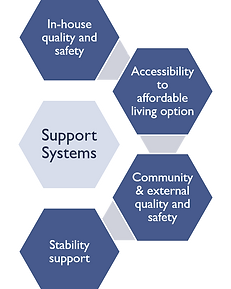
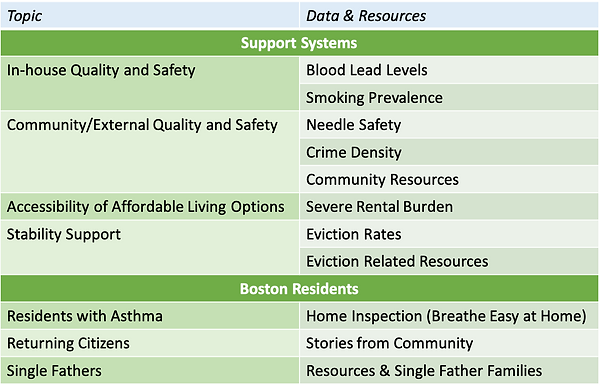
Emphasizing the relationship between health and housing, the tool shares data maps and resources about four categories of support systems: in-house quality and safety, community and external quality and safety, accessibility of affordable living options, and stability support. The tool presents a dynamic model for integrating equity within data sharing efforts that center the lived experience and voices of groups of populations that have been relatively less highlighted in discussions on housing. The interactive tool ultimately aims to promote equitable and safe housing environments in all Boston neighborhoods.

As a part of the Village Vital Signs, the Community Housing Data Tool was developed to provide information and resources to individuals, families, and organizations interested in learning more about the state of housing in Boston communities. Emphasizing the relationship between health and housing, the interactive tool shares data for population health advocacy to advance health equity. Data maps and resources are available in four categories of support systems: in-house quality and safety, community and external quality and safety, accessibility of affordable living options, and stability support. The Data Tool presents a dynamic model for integrating equity within data sharing efforts that center the lived experience and voices of groups of populations (e.g. returning citizens and single fathers) that have been relatively less highlighted in discussions on housing. It ultimately aims to promote equitable and safe housing environments in all Boston neighborhoods.
The Data Tool was co-created with the Community Data Workgroup, a diverse team of individual residents and organizational community partners, who provides valuable direction in forming the framework and topics. As designers, not just as users of the Data Tool, community members have led the process of its development and ongoing plans for expansion. Building on guidance from the data workgroup, the Data Tool intends to make the most relevant information and resources on housing accessible to Boston families.
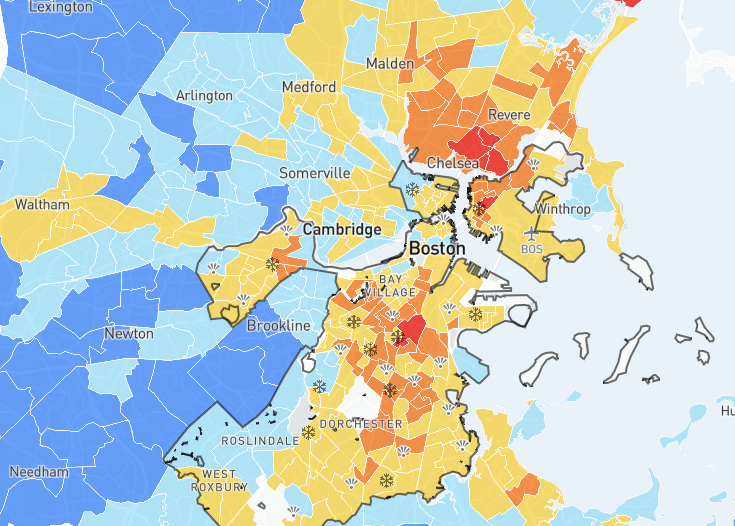
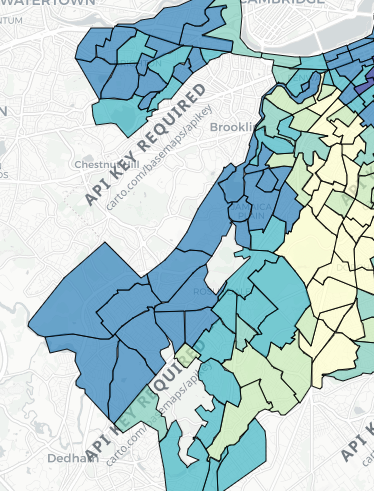
While we use publicly available data, our partners also share valuable data with us. You can learn more about our partners here.Community Housing Data Tool provides data and resources through interactive maps. Interactive maps not only enable users to look for and navigate to resources, but also allow them to observe and understand spatial inequity in data, if there is, among neighborhoods.
*We appreciate the opportunity to participate in CIC-START by Data Across Sectors for Health (DASH), which allowed us to improve the Data Tool to become mobile friendly and further develop the content.
The Community Housing Data Tool intends to make the most relevant information and resources on housing accessible to Boston families in the topics identified by Community Data Workgroup. Please select a page from our library to explore data and resource maps, as well as associated information.
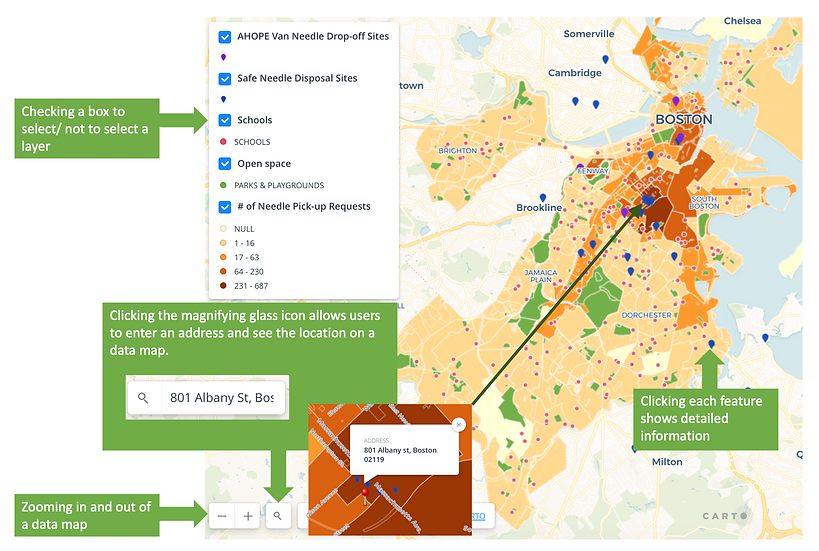
Users can explore each data map by selecting a layer of data, entering an address to pinpoint a place of interest, and clicking features on the map to see more detailed information.
All of the information and resources shared on this tool come from rich partnerships between the Village Vital Signs Community Data Workgroup and other local and national organizations. Learn more about our partners below.
Medical Legal Partnership Boston
Department of Neighborhood Development
Mandela Residents Cooperative Association
Boston Public Health Commission – Breathe Easy at Home
Boston Inspectional Services Department (ISD)