



A child at school writing.
Who we are

The Vital Village Networks is using a collective impact approach to supporting deeper collaboration

The Vital Village Networks is using a collective impact approach to supporting deeper collaboration among educators, clinicians, social service providers, legal advocates and residents to strengthen prenatal, early childhood education, and economic security and preventive legal resources that support family and community protective factors.  We began by developing hubs of innovation within and a formal collaborative network across three Boston Neighborhoods: Dudley (Roxbury/North Dorchester), Mattapan, and Codman Square (Dorchester).

We align preventive efforts across sectors to enhance existing services for children.  This approach is sustainable because we embed community-driven preventive strategies in the context of existing systems for child health and education and community development.  We strive to connect and strengthen opportunity structures that support protective factors and family strengths within existing community resources.  We couple community-based participatory research and improvement science methodology to drive progress.

How Does A Collaborative Network Enhance Synergy?

Emerging understanding of the far-reaching consequences of early-life adversities and toxic stressors on child development, health, and educational outcomes motivates a paradigm-shift toward the use of innovative approaches that harness collective capacities.  Our Network is developing a community of practice that mobilizes cross-sector collaborations, encourages collective learning, and cultivates stronger connections between community residents and community agencies in order to co-design and improve community systems.  We link learning and practice through an intentional improvement process, so that research insights are translated and inform practice and practical problems are rigorously studied.  Our long-term goal is to pioneer a sustainable approach to setting-level improvements that enhance family and community protective factors and ultimately prevent and mitigate childhood adversities and promote optimal wellbeing.

Our Mission

Vital Village is a network of residents and agencies committed to maximizing child, family, and community wellbeing.

Our Vision

To cultivate collective responsibility for all children.

Theory of Change

Our network is expanding a community of practice that encourages collective learning and works to advance equity. Vital Village supports existing community efforts and cultivates stronger connections between community residents and community agencies in order to achieve equitable community systems (social processes, resources, and social arrangements).  We also strive to build alliances with a diversity of sectors to support social change. Improving community systems will support setting-level improvements that enhance family and community protective factors and ultimately prevent and mitigate childhood adversities and promote optimal wellbeing.

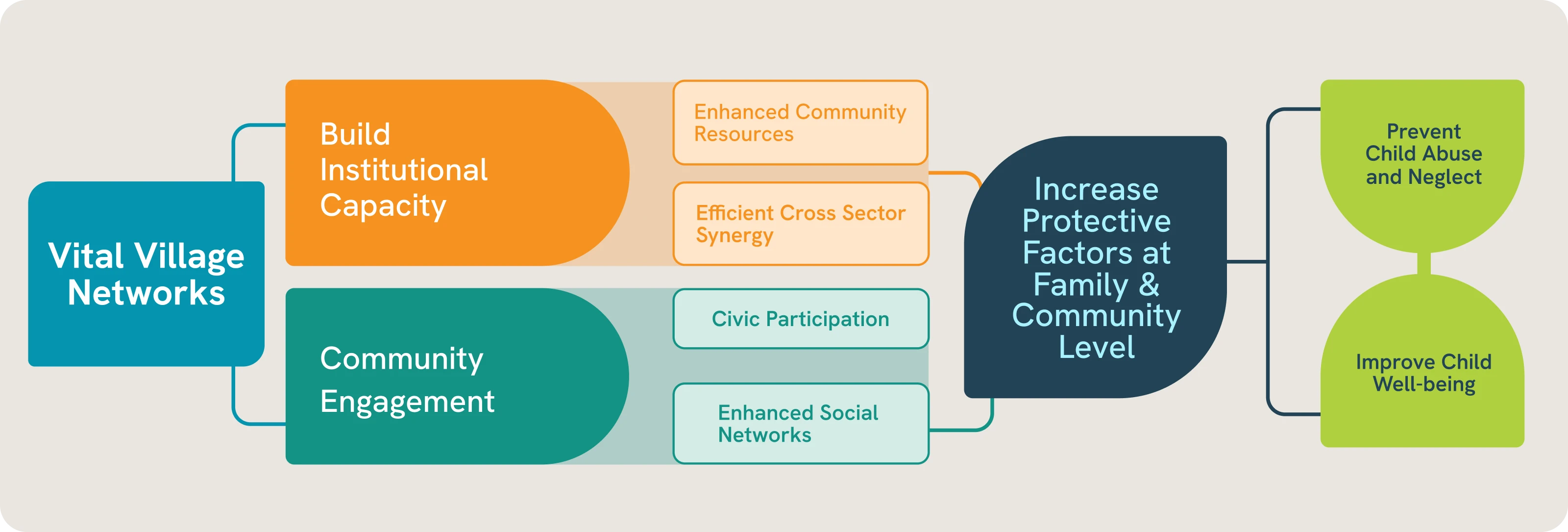
About Vital Village Network. Graphic divided into two main fields. Build Institutional capacity that allows for enhanced community resources and efficient cross sector synergy. And Community Engagement that allows for civic participation and enhanced social networks. These lead to the increase of protective factors at family and community level helping to prevent child abuse and neglect and improve child well-being.About Vital Village Network. Graphic divided into two main fields. Build Institutional capacity that allows for enhanced community resources and efficient cross sector synergy. And Community Engagement that allows for civic participation and enhanced social networks. These lead to the increase of protective factors at family and community level helping to prevent child abuse and neglect and improve child well-being.

What Do We Hope to Achieve?

We aim to deepen community engagement within, and grow the interdependence and scale of the Vital Village Network across three Boston neighborhoods.  We have four main objectives to achieve our vision.

Vital Concept

To support growth of a local community of practice to cultivate community settings which protect children from violence and optimally support their well-being.  We support leadership trajectories for community residents to build collective capacity, and link learning to practice within innovation hubs driven by iterative learning processes, collaborative inquiry, and community-based evaluation.

Village Vital Signs

To improve the quality of data and tools which allow community residents and community institutions to promote family and community safety.  We leverage existing data systems to establish benchmarks for assessing the wellbeing of children and use them to catalyze community engagement and accountability.

Vital Connections

To cultivate social networks which provide meaningful opportunities in daily life for social and emotional learning and build family resilience and community prosperity.  We support peer-to-peer advocacy, youth civic participation, and cultivate regular dialogue between community agencies and residents to increase collective engagement to build the geography of opportunity structures in neighborhoods.

Village Prosperity

To optimize the prosperity of Vital Village neighborhoods through peer-to-peer advocacy models to address social and material hardships using coordinated economic and preventive legal strategies. We are scaling a model for building civic capacity and community member peer advocacy skill supported by local institutions.

System Change

Community of Practice

In 2013, our strategic planning year catalyzed the evolution of our Network from a collaborative group into a community of practice.  Innovation pilot projects facilitated and strengthened cross-sector partnerships and seeded novel approaches to common challenges.  Our community of practice also supported the co-creation and design of innovations between resident partners and community-based agency partners with shared accountability.  These collective actions of the network allowed for a planning phase that moved from blueprint design and visioning to learning through action and efficient piloting of proposed ideas.  We coupled community-based participatory research with improvement methodology to support an iterative and transparent improvement process.

Our innovation projects use an action-oriented learning approach that also serves to build collaborative efforts. More important than any individual project is the potential to support shared learning and collaboration across sectors, within and across neighborhoods, and between community agencies and residents.

This model also strengthened our ability to engage novelty in research-practice partnerships across sectors of health, education, family services, economic stabilization, and legal advocacy and encourage translation and enhancing evidence-based practices to promote child well-being and support protective factors within setting-level

Our Emerging Concept of Place

We understand social settings to be dynamic systems. A central goal of our network is to develop hubs of innovation within and a learning system across neighborhoods.  Through our planning process we embraced unique characteristics of each community and the connections between these neighborhoods, and the fluidity and mobility of residents between them for health and education services, social networks, enrichment, and life experiences.  Our focus has evolved to include not only the footprint of each neighborhood, but the corridors—routes of social networks, commerce, and information—between these places.  As we develop strategies to improve child, family, and community well-being we are exploring how network capacity would be enhanced by strategies that deepen penetration of ideas locally, and spread of network capacity along corridors.

How Does A Collaborative Network Enhance Synergy?

Vital Village Networks strives to enhance existing efforts to promote child, family, and community wellbeing.  Our Network is working to build capacity and develop leadership with existing resident-led community groups.  In this effort we have helped bridge policy, research, and practice to advance equitable systems of care and education.  We have also identified common challenges for resident-led groups and our support includes: conflict-resolution, collaborative leadership, facilitation, meaningful use of data, quality improvement, evaluation, coaching, and using the network to support resource connections.  We also served as a liaison for programs at Boston Medical Center that desired to be based in the community, collaborate with community-based organizations, or engage community residents in co-designing healthcare services and health systems.

Network Connection Meetings

The goals are to promote shared learning and collaboration by creating a space that allows for connections and building relationships and collective responsibility.

Healthy Network Workshops

Support skills and improvement tools to enable partners to grow in capacity and as leaders.