

Early childhood education can produce significant gains in learning, development, and life chances. Early childhood education programs (designed for children ages 3-5) are provided in childcare, daycare, preschool, and pre-kindergarten settings. They may be located in center-based, home-based, or public school settings, and they may be part-day, full-day or year-round. They can also be privately run, operated by a local school system, or operated by a federally funded program like Head Start.
* Block group – A block group is a subdivision of a census tract. It is the smallest geographic unit for which the Census Bureau tabulates data. Block groups generally contain 600 - 3,000 people.
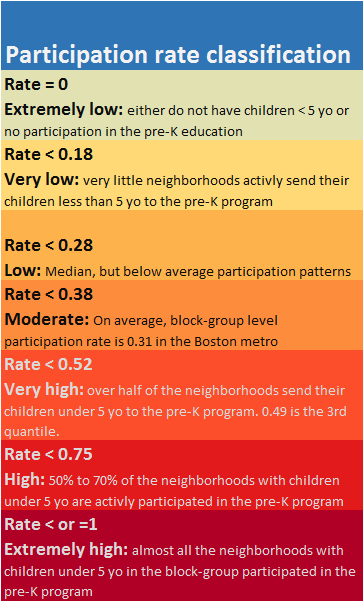
Early childhood education participation rate is the ratio of number of children (3 years and older) attending preschool or nursery school in a block group to total number of children < 5 years old in that block group.
U.S. Census Bureau, American Community Survey, 2010-2014 5 year estimates
Footnote: For the Block Group Level, the number of children who were 3 or 4 years old was not available. Thus, we used children 5 years old as the substitute. In some cases, older children are included in the number of children attending preschool/nursery school, which caused the ratio to be over 1.0. In those cases, we coded a ratio that’s greater than 1.0 as 1.0. For those block groups where data was not available (i.e. no children younger than 5 or children younger than 5 unknown), we coded them as 0.
Nurturing Leadership from the community, for the community


